
Affiliate disclosure: This article may contain affiliate links. If you buy through them, we may earn a commission at no extra cost to you. As an Amazon Associate I earn from qualifying purchases.
Choose the power arrangement you can maintain
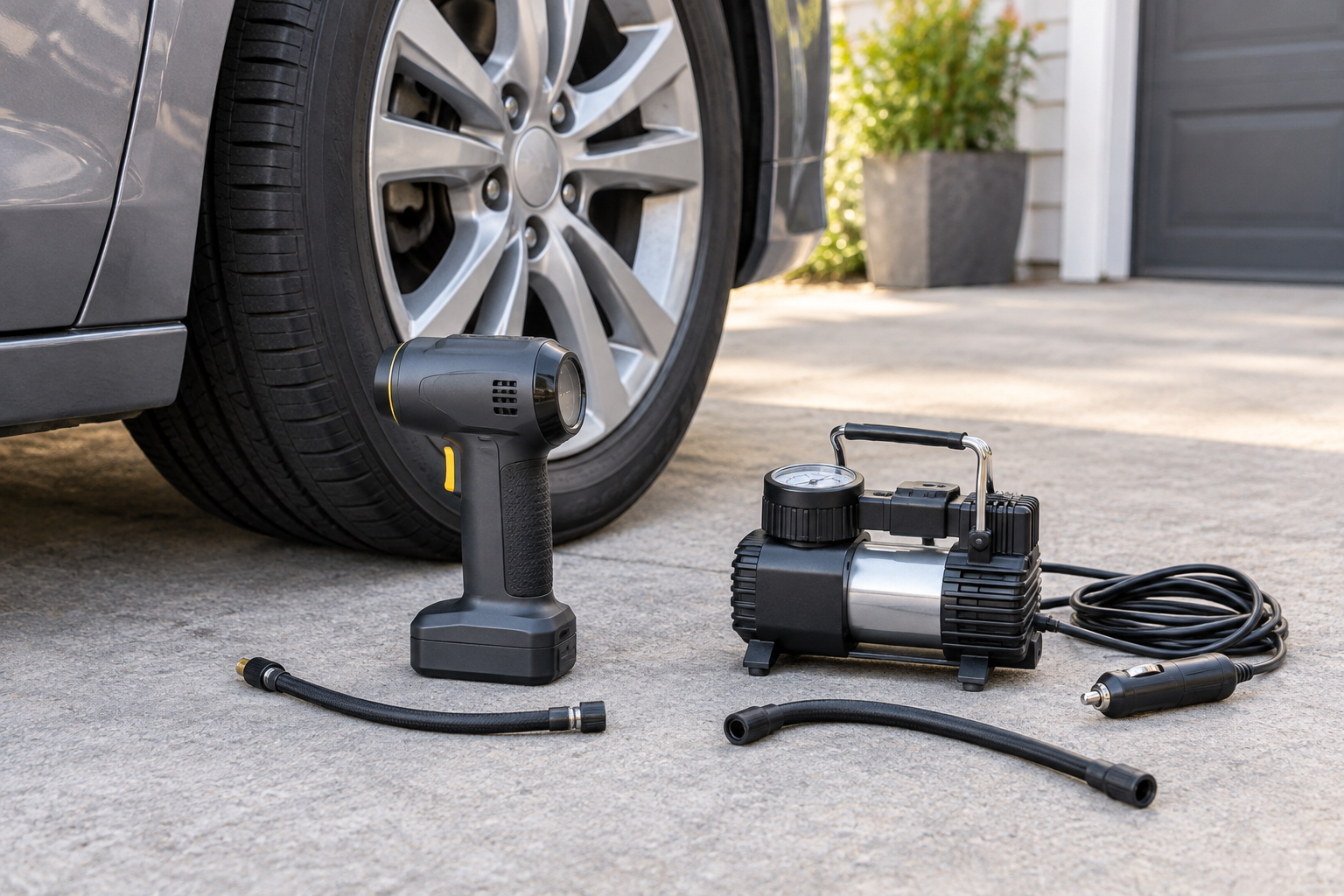
A cordless inflator is convenient when you want to move freely around a vehicle or inflate something away from its accessory socket. A 12-volt pump removes the need to keep an internal battery charged, but it relies on a compatible vehicle outlet and enough cable reach. For routine passenger-car top-ups, power access is often the more useful distinction than maximum pressure.
The AstroAI L7 Orange cordless inflator and AstroAI Yellow 12V DC integrated-storage pump illustrate those options. This guide does not report inflation-speed testing, full-flat recovery or measured battery runtime. An inflator is not a repair for a damaged tire or a reason to keep driving on one.
L7: check charging before you need it
The selected L7 offer is the Orange single inflator, ASIN B0CS3B7MD8. Its battery-powered arrangement suits quick movement between tires without routing a vehicle power lead. Keep its charging lead with it and make checking its charge part of your vehicle maintenance routine.
The exact Orange L7 listing calls for a 10-minute rest after 15 minutes of continuous use and excludes tires larger than 25 inches, including the heavy-duty examples it names. These are seller-listing operating limits, not tested results. A 150 psi ceiling alone does not establish suitability for every tire volume or inflation job.
12V DC: verify the outlet requirement
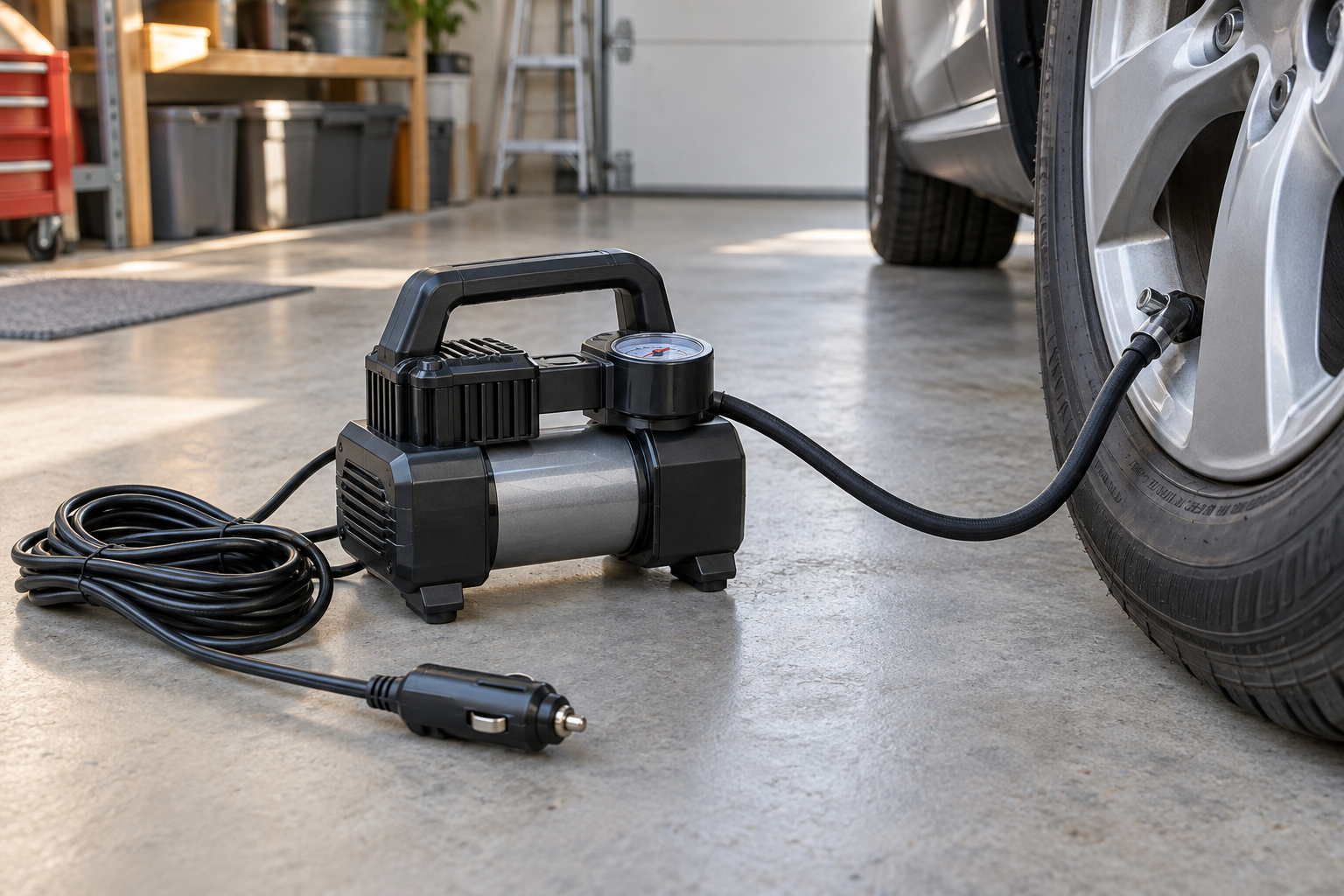
The selected Yellow pump, ASIN B097B6X669, is the single 12V DC product with integrated storage. Its listing specifies a 12V DC 15A accessory socket. Check the vehicle manual’s socket rating before assuming that a visually similar outlet is suitable. This model is not a household AC pump.
Check the route to the farthest wheel, not just the tire nearest the socket. The power lead and inflation hose are different parts of that route. Their combined stated reach does not establish unobstructed access in your particular vehicle.
Use the vehicle’s cold-pressure recommendation
NHTSA directs drivers to the vehicle manufacturer’s recommended cold inflation pressure on the vehicle placard or in the manual. The tire sidewall’s maximum is a different number. A pump’s preset or maximum pressure does not decide the correct target for your car.
Read and set the target carefully, then check the result with a suitable tire gauge. Watch for a tire that repeatedly loses pressure and arrange appropriate inspection. A useful top-up tool should support maintenance; it should not obscure a leak or damaged tire that needs attention.
Cooling and tire size matter
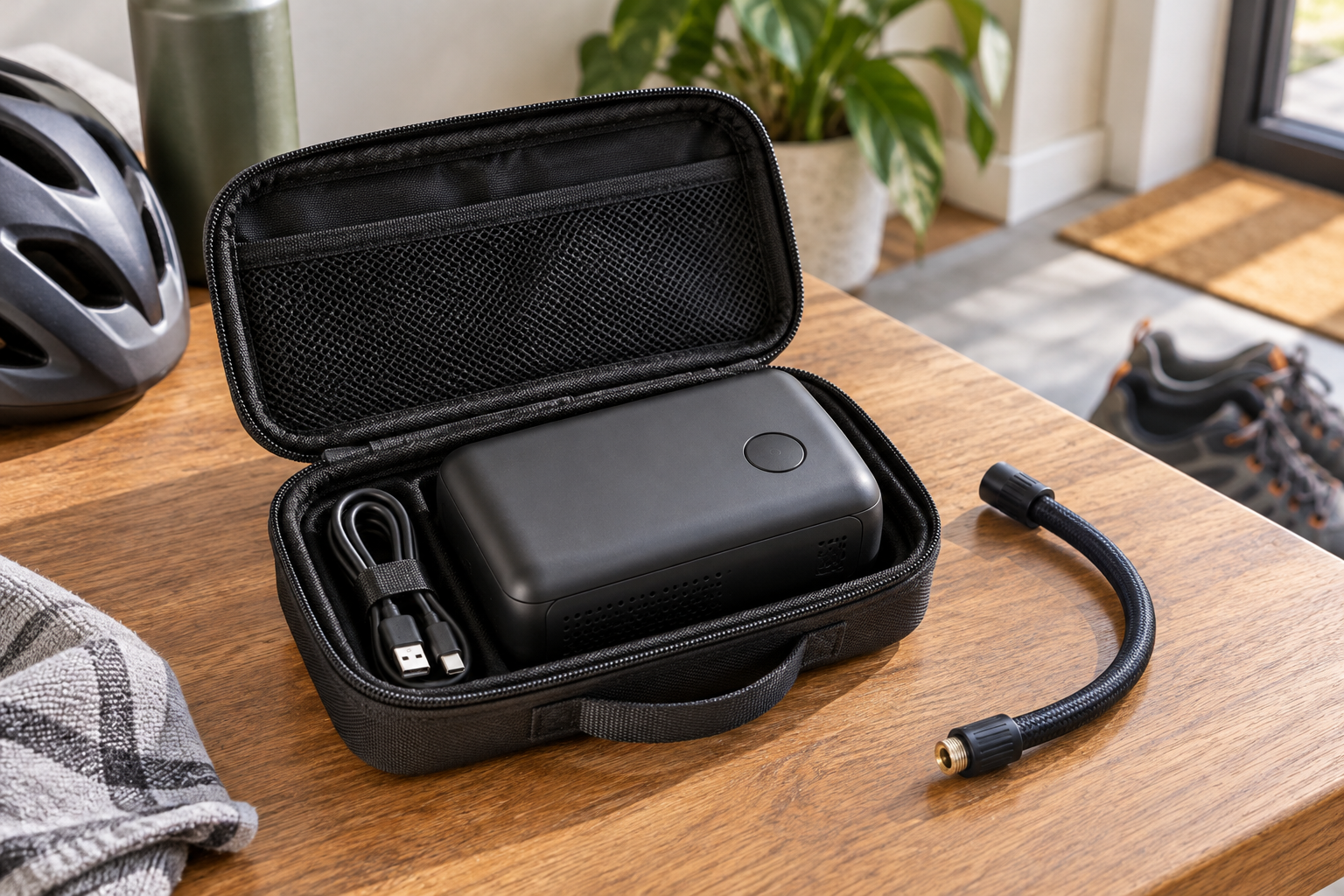
For the Orange L7, follow the exact listing’s 15-minute continuous-use limit and 10-minute rest. The selected Yellow 12V listing also calls for cooling after 15 minutes of continuous operation but does not give a precise rest duration in that description. Use the supplied model instructions if they impose stricter limits.
Plan a succession of top-ups around those cooling requirements. Tire volume, starting pressure and condition affect the work required. This guide supplies no measured inflation speed, full-flat recovery result or number of complete tires per battery charge; read the exact instructions and confirm the intended tire type.
Swipe horizontally or focus the table and use the arrow keys to view all comparison columns. ↔
| Practical requirement | L7 cordless | Yellow 12V DC |
|---|---|---|
| Power before use | Charged internal battery | Compatible vehicle accessory socket |
| Moving around vehicle | No vehicle power lead | Lead must reach the work area |
| Storage check | Charge and charging cable | Power lead, plug and hose |
| Long use | Follow cooling limits | Follow cooling limits |
| Heavy-duty tires | Do not infer support from maximum psi | Confirm supported tire and vehicle type |
The better glovebox choice depends on you
Choose the L7 if cordless access is valuable and you will keep it charged. Choose the 12V pump if the socket requirement and cable route work for your vehicle and you prefer to avoid battery upkeep. Before relying on either, read the supplied instructions and confirm that your tire type is supported.
Keep the hose, valve connection and essential accessories accessible in storage. Check the tool before a long trip rather than assuming months in the car leave it ready.
Related reading
Keep the inflator, hose and essential accessories easy to reach in the vehicle. The linked trunk organizer guide can help you plan a storage position that avoids burying them under other gear.